The Panama disease
tracker.

A soil fungus has already killed the world's favourite banana once. A new strain, Tropical Race 4, is now working through the banana that replaced it. Where it has reached, what it is costing, and how we got here.

TR4 foundBig exporter, no TR4
202629 places
EPPO's list, updated August 31, 2026

29 places with TR4

  1. The world's largest exporter. Confirmed in December 2025 on a 7-hectare farm in El Oro, then on the neighbouring property in July 2026.

    Exported 6.5 million tonnes in 2025.

Places with TR4
29
4 in the Americas, all since 2019
Exports exposed
63%
of world banana exports ship from a country where TR4 has been found
Known cure
None
No effective fungicide or eradication method exists
In the soil
30 years
How long it can survive with no banana plants
The spread

8 places by 2012. 21 more since.

For decades TR4 stayed in Asia and the Pacific. In 2013 it turned up on an export farm in Mozambique, the next year in Jordan, and in 2019 in Colombia: its first landfall in the Americas, where most of the world's export bananas grow.

This counts places, not damage. A first report can be one small farm, and reports lag: Bangladesh's came more than a year after the symptoms were seen.

Places where TR4 has been found

By the year it was first found. The earliest dates are approximate.
The impact

Exports are at a five-year high. TR4 is inside the biggest exporters.

World banana exports rose to 21.7 million tonnes in 2025, the most in five years. FAO also names TR4 among the forces shaping the trade: lost production, and the money spent keeping the fungus out.

63%

of world exports ship from a country with TR4

That counts a country's whole exports, however little of it is affected: one outbreak in one province puts all of a country's shipments in this figure. It measures how close the fungus has come to the trade, not how much of the trade it has hit.

Latin America and the Caribbean shipped 71% of the world's exports in 2025. Before 2019, TR4 had never been found there.

Banana exports, 2025

Million tonnes, from FAO's Banana Market Review.
  • Ecuador6.5
  • Philippines3.0
  • Colombia2.6
  • Guatemala2.3
  • Costa Rica2.2
  • India1.1
  • Vietnam0.50
  • Mexico0.40
  • Côte d’Ivoire0.36
  • Cambodia0.31
  • Cameroon0.23
  • All others2.2
TR4 foundNot on EPPO's list
October 2026
2 cases

Ecuador

The world's largest exporter, at 6.5 million tonnes. TR4 was confirmed on a 7-hectare farm in El Oro in December 2025, and on the neighbouring property in July 2026. Floods reached the area in October, and officials widened their surveillance ring from 5 to 8 km as a precaution.
Early 2025
51,000 of 89,000 ha

Philippines

How much of Mindanao's banana land was still working, according to the growers' association, with much of the rest ruined by the disease. New planting in the Cagayan Valley helped exports rebound about 30% in 2025, to 3 million tonnes.

To 2015
US$374 million

Indonesia, Taiwan, Malaysia

The only published loss estimates when they were reviewed in 2015: US$121 million in Indonesia, US$253 million in Taiwan and Malaysia. TR4 may by then have affected up to about 100,000 hectares worldwide. We found no newer global count.

The price

The price, so far.

The US import price was $1.12 a kilo in Sep 2026. That is +10% on a year earlier. Its high in the last 20 years was $1.68, in Dec 2022.

The price alone won't tell you what TR4 is doing: FAO lists weather, costs and demand among the things moving the trade, alongside disease. It is the number to watch if a big exporter's output starts to fall.

Banana import prices

US dollars per kilogram, monthly average, last 20 years.
  • United States
  • Europe
World Bank Commodity Price Data
The history

The banana has died once already.

Until the 1950s the banana in almost every shop was the Gros Michel. A fungus in the soil wiped it out of the export trade, and the industry survived by switching to a banana that resisted it. That banana is the Cavendish, and it is the one dying now.

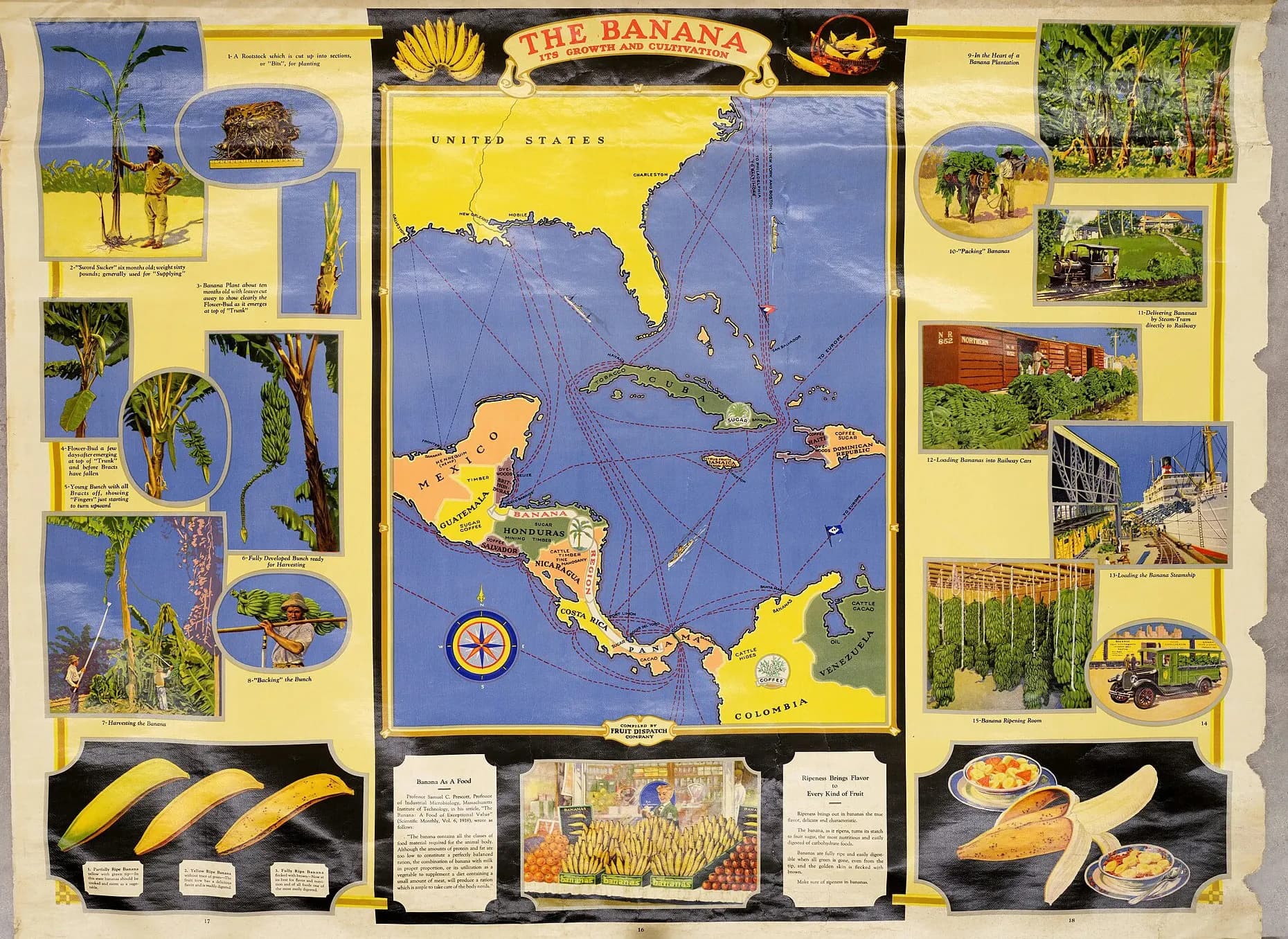
A colourful wall map of the Caribbean and Central America, showing banana shipping routes to the United States, surrounded by pictures of banana growing, loading and ripening.
The Banana: Its Growth and Cultivation, a wall map from about 1929 by the Fruit Dispatch Company, United Fruit's distribution arm. The fungus was already in the plantations it celebrates. Public domain.
Act one

Gros Michel

The export banana trade was built on one variety. It took the fungus about 70 years to bring it down, and the companies spent most of them running.

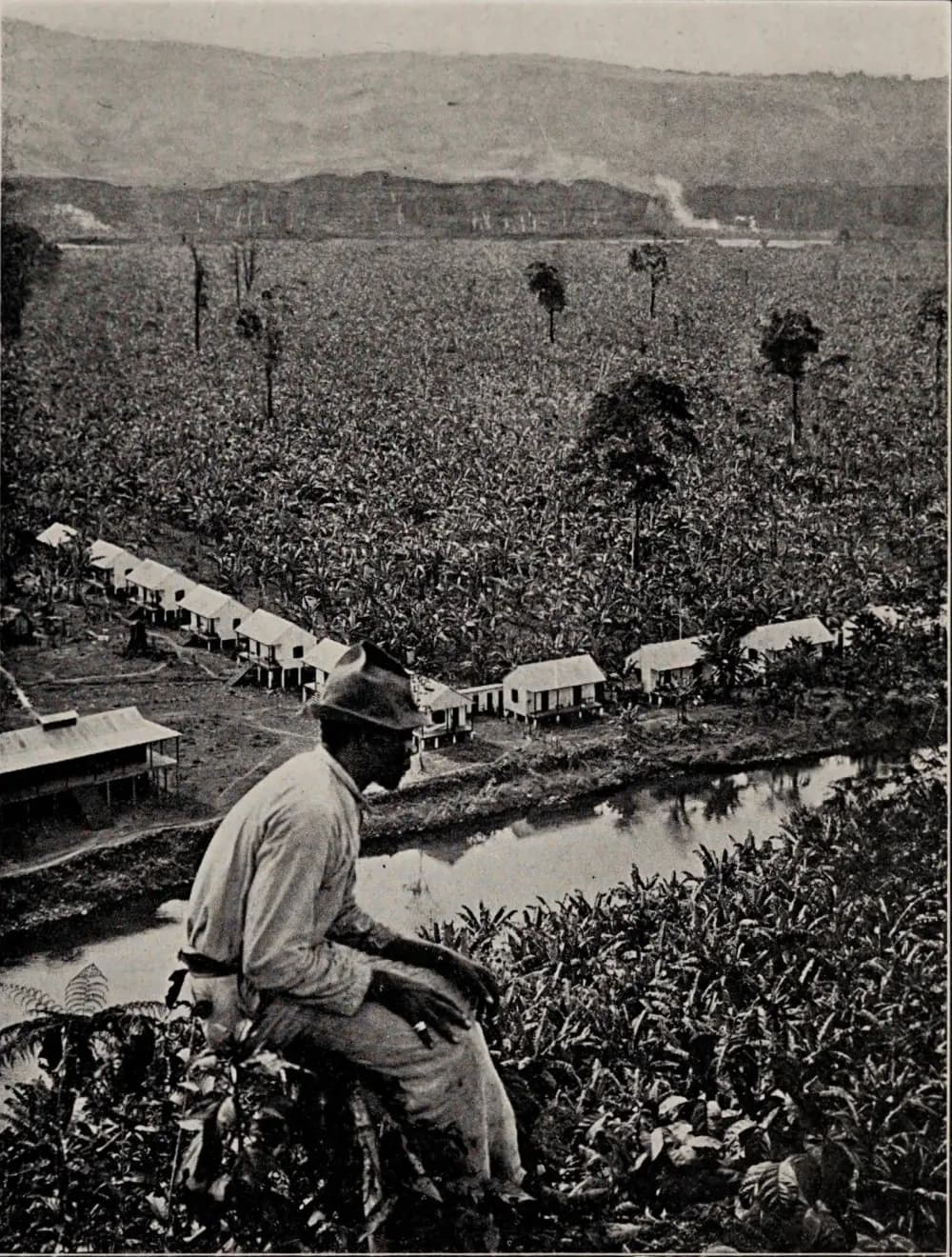
A man sits on a hillside above a vast banana plantation, with workers' houses and a river below.
A plantation near Port Limón, Costa Rica, about 1923. Photo: Underwood & Underwood, in Artemas Ward's The Encyclopedia of Food. Public domain.
  1. 1876

    First report, in Queensland

    A wilting disease of bananas is recorded in Australia, half a world from where it will do its worst.

  2. 1890

    It reaches the plantations

    Growers see it in Gros Michel fields in Costa Rica and Panama. Railways have just made industrial banana farming possible, all of it on one variety. Panama lends the disease its name.

  3. 1910

    A name for the killer

    The cause is traced to a soil fungus, identified in Cuba: Fusarium oxysporum f. sp. cubense.

  4. 1900–1960

    Run to new land

    With no cure, companies abandon infected farms and clear fresh forest, often carrying the fungus with them on infected planting material. More than 100,000 hectares of Central American plantations are destroyed: 30,000 in Honduras's Ulúa Valley alone, 6,000 around Quepos in Costa Rica in 12 years.

  5. 1923

    Yes! We Have No Bananas

    A novelty song becomes one of the year's great hits. Some have linked it to a shortage caused by the disease. Nobody has shown that it was.

  6. 1933

    Not if, but when

    Jamaica's governor says the final destruction of Gros Michel is a question of when, and that the island's industry depends on an immune variety the market will accept.

  7. 1950–1960

    The switch

    Running out of clean land, the companies replant with Cavendish, which resists the strain killing Gros Michel. By the 1960s the conversion is done. The losses come to at least US$2 billion in 2005 dollars, and the disease is soon forgotten as a threat to the trade.

Then and now

Same fungus, same mistake, one big difference.

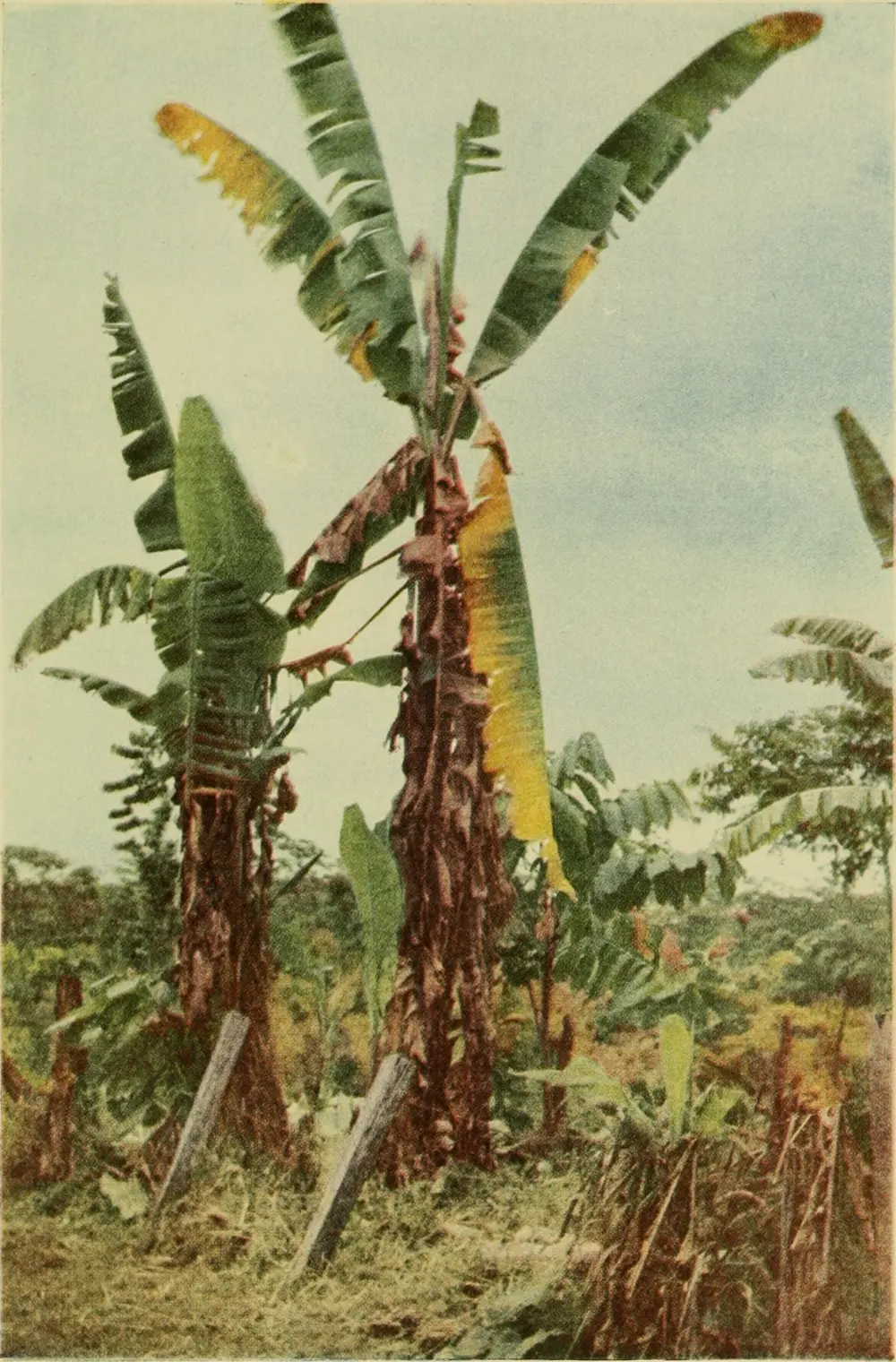
A hand-tinted plate of a tall banana plant with yellowing leaves and a brown, collapsed stem.
A Gros Michel plant in Costa Rica attacked by the wilt. E. W. Brandes, Banana Wilt, Phytopathology, 1919. No known copyright restrictions.
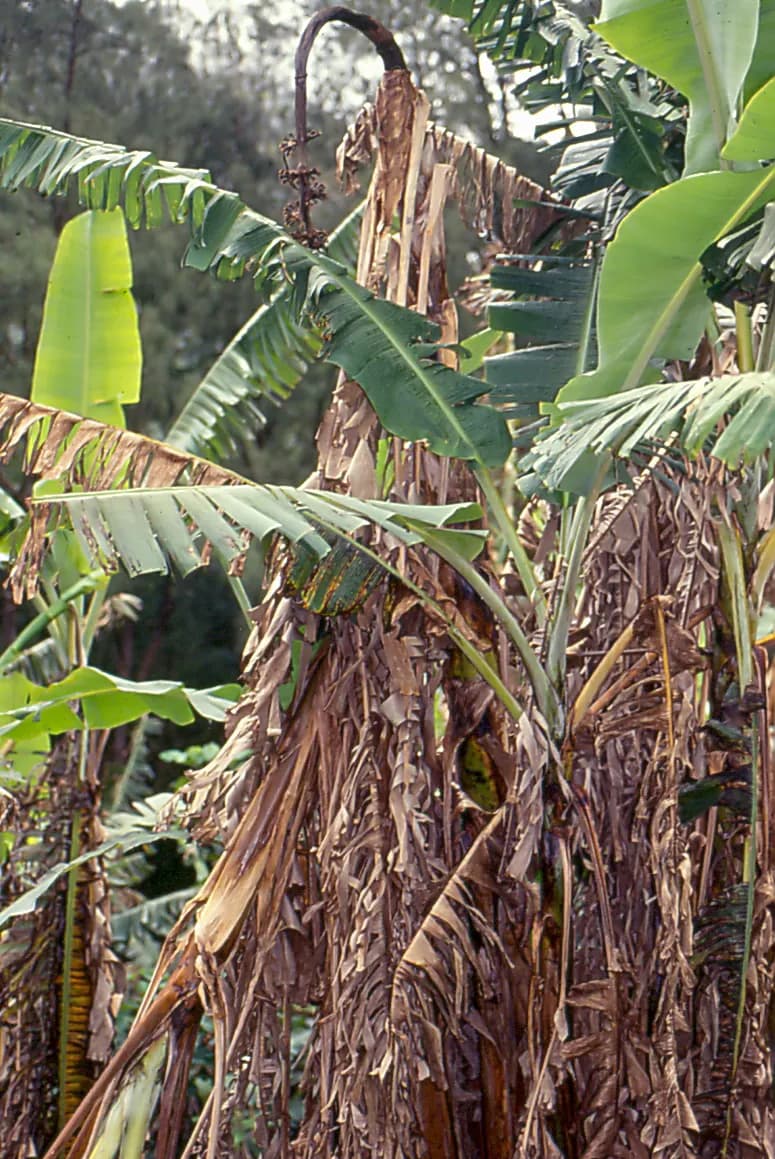
A banana plant with brown, collapsed leaves hanging around its stem and green leaves still above them.
A banana plant with Panama disease, 2005. Photo: Scot Nelson, CC0.
ThenNow
The bananaGros Michel, the variety behind nearly all export bananas.Cavendish: just under half of world production, about 50 million tonnes a year, and the backbone of the export trade.
The fungusRace 1 of Fusarium oxysporum f. sp. cubense.Tropical Race 4, which also kills varieties that races 1 and 2 attack.
First seenAustralia in 1876; Costa Rica and Panama in 1890.In Cavendish in Taiwan in the late 1960s; named in 1994.
Why it spreadOne clone planted across a whole industry, moved on infected plant material.The same. Sequencing suggests a single clone of the fungus is behind TR4's spread, moving on soil, tools, plants and water.
The tollMore than 100,000 hectares in Central America, and at least US$2 billion in 2005 dollars.Still being counted. About 80% of the world's bananas and plantains are varieties TR4 can infect.
The way outA resistant banana already growing, ready to replace it.No replacement on the market. One GM variety approved but not grown commercially; the first bred line is expected around 2028.
Act two

Cavendish

The banana that saved the trade resisted the strain that killed Gros Michel, not the fungus. The warnings came early.

Extremely vulnerable to a new disease, especially a tropical race of Fusarium wilt that could devastate the basis of the industry.

R. H. Stover on the Cavendish export trade, 1986
  1. 1830–1835

    A curiosity in a Derbyshire greenhouse

    Long before anyone needs it, head gardener Joseph Paxton raises a banana from Mauritius at Chatsworth House and names it after his employers, the Cavendish family. Chatsworth counts it as the ancestor of almost every banana eaten in the West today.

  2. 1967

    Cavendish starts dying in Taiwan

    Panama disease appears in Cavendish in Taiwan in the late 1960s. It is a new race of the same fungus.

  3. 1986

    The warning

    Plant pathologist R. H. Stover warns that the export trade is extremely vulnerable to a tropical race of the wilt that could devastate the Cavendish varieties it rests on.

  4. 1990–1994

    The warning comes true

    Within a few years, new Cavendish plantations in Southeast Asia begin to die. In 1994 the cause gets its name: Tropical Race 4.

  5. 2005

    Into the Philippines

    A survey of commercial Cavendish farms confirms TR4 in Asia's biggest banana exporter. Epidemics follow across Mindanao.

  6. 2013

    Out of Asia

    TR4 turns up on an export farm in northern Mozambique, and is confirmed in Jordan the next year. It has left its home region.

  7. 2015

    Back in Queensland

    Known near Darwin since 1997, TR4 reaches the Tully Valley, the heart of Australia's banana industry.

  8. 2019

    The Americas

    Colombia confirms TR4 on plantations in La Guajira, the first outbreak in the region where most export bananas grow.

  9. 2021–2023

    Peru, then Venezuela

    Peru finds it on a half-hectare plot in Piura in April 2021. Venezuela confirms it in January 2023, on plantain as well as Cavendish.

  10. 2024

    A banana that resists it

    Australia approves QCAV-4, a Cavendish given a resistance gene from a wild banana: the first GM Cavendish cleared to grow and eat. It isn't grown commercially.

  11. 2025

    The biggest exporter

    A suspected outbreak is reported in September on a 7-hectare farm in El Oro, near the Peruvian border, and officially confirmed in December.

  12. 2026

    A second case, then floods

    In July a second case is confirmed on the neighbouring property. In October floods reach the area, and officials widen their surveillance ring from 5 to 8 km.

Know the disease

How it kills a banana plant.

Panama disease, or Fusarium wilt, is caused by a fungus that lives in the soil. It kills the plant and doesn't harm people: bananas from an affected farm are safe to eat.

  1. 1

    Soil moves

    Spores travel on boots, tools, vehicles, planting material and floodwater. In Peru, flooding in 2023 took monthly outbreaks from nine to 50.

  2. 2

    In through the roots

    The fungus enters through the roots and climbs the plant's water vessels, blocking them.

  3. 3

    Yellow, then collapse

    The older leaves yellow and hang down around the stem, and the stem stains brown inside. An affected plant stops being productive.

  4. 4

    It stays

    Spores can survive in the soil for up to 30 years with no banana in it. FAO says no effective fungicide or eradication method exists, so infected ground is largely lost to any banana the fungus can kill.

The way out

What could stop it.

Nothing yet clears the fungus from the soil. The options are keeping it out and growing something it can't kill. FAO's open question is whether traders, retailers and shoppers will accept a different banana.

Approved, not grown

A GM Cavendish

QCAV-4 carries a resistance gene from a wild banana. One of 50 plants was infected after five crop cycles in its latest field trial. Australia approved it in 2024, but it isn't grown commercially, and a first trial in the Philippines was only planned for 2025.

In trials

New hybrids

North Queensland Banana Research and Honduras's FHIA breeding programme have 30 to 40 hybrids under evaluation and expect a first Cavendish line by 2028. A new banana also has to taste, ripen and ship like the old one, which is where FAO sees the doubt.

The record

What's new.

What the trade press and Latin American papers are saying, and EPPO's own reports on TR4.

In the press

Headlines in the language they were written in, updated through the day.
  1. Banano colombiano enfrenta la amenaza del Fusarium: CAN y Alemania refuerzan estrategia para proteger los cultivos
    Portafolio.co · October 31, 2026
  2. Comunidad Andina y Alemania se alían contra el Fusarium Raza 4, un hongo que amenaza los cultivos de banano
    El Universo · October 30, 2026
  3. Alianza regional busca frenar el avance del Fusarium R4T
    El Productor (Ecuador) · October 30, 2026
  4. Agrocalidad coloca señalización preventiva contra el Fusarium raza 4 en El Oro
    El Universo · October 27, 2026
  5. ECUADOR: Inundaciones en Santa Rosa amplían vigilancia por Fusarium R4T
    El Productor (Ecuador) · October 21, 2026
  6. El agua llegó a la finca con Fusarium R4T y crece el temor entre bananeros
    Diario Extra · October 20, 2026
  7. ‘Fusarium’ raza 4: Agrocalidad amplía a 8 kilómetros el cerco de bioseguridad en El Oro
    El Universo · October 20, 2026
  8. Exportaciones de banano crecen 24,6 %, pero el Fusarium afecta más de 1000 hectáreas en Piura
    AGROPERÚ Informa · October 19, 2026

EPPO Reporting Service

Its articles about a single place.
  1. First report in Bangladesh
    EPPO 2026/193 · Aug 2026
  2. First report in Nepal
    EPPO 2026/145 · Jun 2026
  3. Officially confirmed in Ecuador
    EPPO 2026/015 · Jan 2026
  4. First suspected outbreak in Ecuador
    EPPO 2025/268 · Nov 2025
  5. First report in Mayotte
    EPPO 2020/016 · Jan 2020
  6. First report in Türkiye
    EPPO 2020/015 · Jan 2020
  7. Update on the situation in Israel
    EPPO 2019/059 · Mar 2019
  8. Incursion and eradication in Israel
    EPPO 2018/106 · May 2018
Questions

Panama disease, briefly.

What is Panama disease?

Panama disease, or Fusarium wilt of banana, is caused by a soil fungus, Fusarium oxysporum f. sp. cubense, that blocks the plant's water vessels and kills it. One strain, race 1, wiped the Gros Michel banana out of the export trade by the 1960s. A newer strain, Tropical Race 4 (TR4), attacks the Cavendish, the banana that replaced it.

Will bananas go extinct?

No. More than 1,000 varieties of banana exist. What's at risk is the Cavendish as the cheap, uniform global banana, and the farms and jobs built on it.

Are bananas from infected farms safe to eat?

Yes. Government and industry sources agree that the fungus kills the plant, isn't harmful to people and doesn't affect the fruit.

Which countries have TR4?

EPPO's list, updated August 31, 2026, has 29 countries and territories, 4 of them in the Americas: Colombia, Ecuador, Peru, and Venezuela. Ecuador, the world's largest exporter, confirmed its first case in December 2025. The globe at the top of this page has them all.

Why can't growers just switch bananas again?

Last time a resistant variety was already available to plant. This time no such banana is on the market. The leading candidates are a GM Cavendish approved in Australia but not grown commercially, tolerant Cavendish clones with disputed field results, and new hybrids expected from 2028.

Avos Alerts

Know when it moves.

Avos reads the sources around the clock and emails you when something you follow changes.

TR4 reaches a new countryA new case in EcuadorA first case in Guatemala or Costa RicaA resistant banana gets approved
Start tracking for free
Method

How this page is made.

Atlas, the Avos data engine, reads these sources a few times a day, and a new place on EPPO's list shows up on its own. The history and impact notes are written once from the sources linked beside them, with their dates; they don't update themselves.

1. EPPO's list

The European and Mediterranean Plant Protection Organization's Global Database: where TR4 is and its status, the list FAO cites. It now has 29 places; FAO's 2025 review counted 24. First-report years come from EPPO's country pages and the papers they cite.

2. FAO's trade figures

Full-year 2025 exports from FAO's Banana Market Review. The share of exports is our own sum: the exports of every country on EPPO's list, over the world total.

3. Prices and the press

Monthly import prices from the World Bank, and headlines from an English and a Spanish news search, kept only if they name the disease and the banana. No model rewrites them.

For information only: not agricultural or investment advice, and not an official pest status. Follow your national plant protection organization. Sources: EPPO (2026) EPPO Global Database, gd.eppo.int. FAO. 2026. Banana Market Review 2025. Rome, CC BY 4.0; FAO does not endorse this page. World Bank Commodity Price Data (The Pink Sheet), CC BY 4.0.

See every tracker